Before you buy FDA-approved PTFE conveyor belt options from a seller, you should carefully look at their credentials, the goods' certifications, and the paperwork that shows they follow the rules. Polytetrafluoroethylene belting systems that are safe for food are made by top companies like Aokai PTFE and are offered by qualified equipment providers and specialized industrial wholesalers. These places keep quality standards high and give you the FDA compliance certificates you need to make sure your food processing follows the rules and gets the best resistance to stickiness and temperature.
Understanding FDA-Approved PTFE Conveyor Belts for Food Safety
Polytetrafluoroethylene conveyor systems that have been cleared by the FDA are a big part of how food is processed today. There are a lot of tests and licenses that these different types of belts have to go through to make sure they follow the strict rules set by the Food and Drug Administration for handling food.
What Makes PTFE Conveyor Belts FDA-Compliant
Because of the special materials they are made of and the way they are made, PTFE conveyor belt goods are okay with the FDA. A type of plastic called polytetrafluoroethylene is very chemically neutral. This means that when it's used regularly, it doesn't mix with food or dangerous chemicals. This chemical stability is very important when things are hot and normal materials might break down or hurt food.
A lot of tests need to be done to see if chemicals can move from the belt material to food models when they come into contact with them at different temperatures and times. The FDA has rules (21 CFR 177.1550) that manufacturers must follow to make sure their PTFE binding systems meet those rules. Perfluorocarbon plastics can't be used in ways that come into contact with food without following this rule.
Key Properties That Ensure Food Safety Compliance
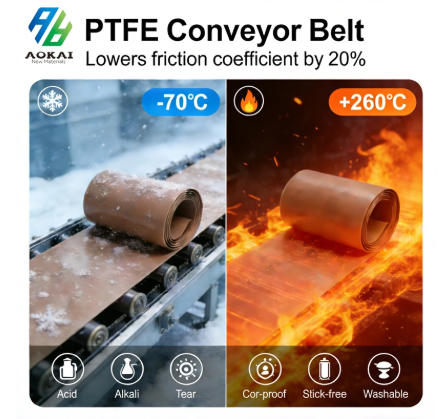
Systems with PTFE belt that have been approved by the FDA work very well and help keep food safe. Because they don't melt in hot weather, these belts can handle temperatures up to 260°C (500°F). Because of this, they are great for cooking, baking, and other jobs that need to be heated up. The belt material stays strong and safe in this temperature range, even when it's being used in tough conditions.
For keeping things clean, the fact that these belts' surfaces don't stick is very important. With this feature, it's easy to get rid of sticky stuff and food scraps don't pile up, where they could harbor bacteria or other germs. It's easier to clean and cleanse fully because the surface is smooth and doesn't have pores. This is required by food safety rules.
It is also important to protect against chemicals. Acids, bases, and liquids that are common in places where food is prepared can't hurt these belts. This guard stops damage that could make the belt less effective and food less safe. Less contact means less energy is used and wear is caused. This means the service life is greater and the performance stays the same over time.
Evaluating PTFE Conveyor Belt Options for Food Industry Applications
There are many PTFE conveyor belt systems on the market for food preparation. To pick the best one, you need to examine each one carefully. Different forms and sizes of belts are used for different jobs, from baking delicate items to processing large amounts of meat.
Comparing PTFE Belts with Alternative Materials
When it comes to preparing food, PTFE binding systems are much better than others made of rubber, PVC, or polyester. It's possible for silicone belts to handle high temperatures, but PTFE is better for use with food because it doesn't stick to food and protects against chemicals. PVC belts are cheap, but they might not be safe for direct food contact with FDA standards because they can't handle the high temperatures needed to handle food.
Polyester belts are strong, but they might not be as resistant to chemicals as PTFE and may need extra coats to make them non-stick. PTFE belting systems are the best choice when you need to follow FDA rules and meet high performance standards because they have a unique set of properties.
Different Configurations and Their Applications
In places that prepare food, different kinds of conveyor systems are used, like roller conveyor sets and slider bed systems. It's easy to use solid PTFE belt with slider beds for jobs that need smooth, continuous surfaces, like making chocolate or fragile pastries. These steps keep the release qualities good and the damage to the product to a minimum.
A lot of roller conveyor systems use PTFE mesh belts because they let a lot of air flow through them. This is great for baking, drying, or cooling. Even though the open mesh design lets air and heat flow, it still doesn't stick and is resistant to chemicals, which are important for food safety. These mesh belts work great in tunnel ovens, spiral freezers, and infrared drying systems where air flow is very important.
Leading Manufacturers and Their Specializations
There are a number of companies that make PTFE fixing systems that are allowed by the FDA. Each one is good at different things. Companies like DuPont and specialty makers like Aokai PTFE work on making belting options for the food business. These businesses keep strict testing facilities and quality control systems in place to make sure that all of their goods follow FDA rules.
When buying teams look at producers, they should check for things like licensing paperwork, expert help, the ability to make changes, and how stable the global supply chain is. A manufacturer that has been around for a while will usually give you a lot of thorough information, like FDA compliance certificates, material safety data sheets, and directions that are specific to your use.
Where and How to Source FDA-Approved PTFE Conveyor Belts for B2B Procurement?
If you want to buy FDA-approved PTFE conveyor belt systems, you need a plan that takes into account the seller's skills, the goods' certifications, and the seller's ability to offer long-term support. Finding these important parts and figuring out how to get them can have a big impact on both how quickly things get done and how well they follow the law.
Identifying Qualified Suppliers and Distributors
Some companies that sell PTFE belting systems and have been cleared by the FDA have facilities and quality control systems that are only for making food-grade goods. When it comes to quality control, these sellers usually have the right licenses, such as ISO 9001. Their factories may also be FDA-registered to make materials that come into contact with food.
When people who work in buying look at possible service providers, they should make sure about a few important things. Lots of paper work, like test results and letters of approval, should be given by providers to show that they follow FDA rules. Also, they should keep systems in place that let them keep track of raw materials and output methods. For government checks and to make sure the quality is good, this is important.
Large networks of accepted suppliers are often kept by companies that make and sell food preparation tools all over the world. Companies like Aokai PTFE focus on making high-quality PTFE products and sell them all over the world. They are an example of a supplier that can give safe and legal choices in places like Vietnam, the Netherlands, and Australia.
Evaluating Supplier Credentials and Certifications
When you do a full study of a provider, you look at a lot of their business and what they can do. Qualifications in quality management show how dedicated they are to producing high-quality goods and growing all the time. The people who make and sell food should keep the right records and show that they know the rules about food safety.
When you judge someone, their technical skills are also very important. Suppliers who are trained should help the mechanic choose the Teflon conveyor belt, help with fitting, and provide professional support after the sale. They should also tell you a lot about the product, such as all of its specs, how to put it, and how to take care of it regularly.
It's even more important that the supply line is stable when you buy things from other countries. It is important for sellers to show that they can consistently ship goods and keep enough stock on hand to meet demand. It's often this level of reliability that sets big companies apart from smaller ones that might not be able to handle large-scale operations.
Procurement Considerations and Best Practices
People who want to buy PTFE belting systems should do more than just look at the product specs. When you buy things and plan your business, minimum order amounts, the ability to adjust, and wait times can all make a big difference.
Companies that process food often need specific belt sizes, surface textures, or edge treatments, so being able to make changes is very important. Suppliers who can make things to order can make solutions that meet the needs of each business and still follow FDA rules.
Some providers charge less for bigger orders, longer contracts, and services that make the product or service better. Other providers charge more for these things. When you buy something, you should still think about how much it costs, but you should also think about quality, stability, and help skills. This will guarantee long-term success in operations.
Making Informed Decisions: Selecting the Right FDA-Approved PTFE Conveyor Belt
To get the best FDA-approved belts, you need to carefully match the product specs with the needs of your business. When hiring teams understand how the features of a PTFE conveyor belt match up with the needs of a job, they can make choices that enhance both food safety and worker productivity.
Matching Belt Properties to Application Requirements
If you want to buy PTFE belting systems, the most important thing to think about is what temperature you need. For jobs like cooking, baking, or thermal processing, you need belts that can keep food safe at high temperatures for a long time. These belts can be used in hot places where other materials might break because PTFE can handle temperatures up to 260°C (500°F).
Chemical interaction is another thing that makes a difference in the belt choice. In the process of making food, cleaning products, food acids, and other things that could hurt belt materials are used. Because PTFE doesn't react with chemicals, you can be sure that belts will keep their properties and stay in compliance even if they are exposed to chemicals that are common in places where food is prepared.
The belt must be able to handle the load and meet the technical needs of the goods. The top of the PTFE is very good, but the structure of the belt below it needs to be strong enough to tear and stable enough to work with the conveyor system. If you know about these basic requirements, you can be sure that the belts you pick will work well under load.
Verification of FDA Documentation and Compliance
By carefully checking your FDA compliance paperwork, you can stay out of trouble with the law and make sure that food safety standards are met. For products that come in contact with food, suppliers should give full certificates of compliance that cover FDA rule 21 CFR 177.1550 and any other rules.
It should be part of the paperwork that test results show agreement with movement limits and other safety factors. Researchers have found that the belts' materials are safe for use when they are used in certain ways. They should make sure that the test settings are like how they will be used to make sure they are following the rules.
You can keep track of materials and production methods with documentation that can be tracked. This is helpful for quality control and possible governmental checks. When suppliers make goods, they should keep records that show where the materials came from, when the goods were made, and the outcomes of any quality checks that were carried out on those goods.
Long-term Partnership Considerations
When you build relationships with skilled providers, you get more than just the goods. You can make PTFE belts last longer and work better by getting them from suppliers who offer full technical support, training programs, and ongoing advice services. When you need to solve a real problem or change the way things are done, these relationships can be very helpful.
When businesses and the law change, suppliers can adapt by coming up with new goods and ideas. Aokai PTFE and other companies like it work on program development and ongoing growth. They can help you find the best ways to process food while still meeting all the standards.
Options for service and support, like help after the sale, expert advice, and emergency response, make operations more reliable. When help is needed quickly, suppliers with global service networks and technology know-how can step in. This keeps the process of making food as uninterrupted as possible.
Conclusion
To find PTFE conveyor belt choices that are FDA-approved, you need to carefully compare providers, make sure you understand the rules for compliance, and plan for your long-term operating needs. Because PTFE materials are unique, these belts are needed to keep food safe in tough handling environments. They have qualities like being strong at high temps, not reacting with chemicals, and not sticking. If you want to buy something, you need to work with approved providers who can show they have the right skills, give you all the paperwork you need, and offer ongoing help. Food preparation businesses can get the best results while always following FDA rules and food safety standards if they choose, put into action, and maintain best practices that have been shown to work in the past.
FAQ
What specific FDA regulations govern PTFE conveyor belts in food processing?
The 21 CFR 177.1550 rule from the FDA says that perfluorocarbon plastics, such as PTFE, can be used in places where food will touch them. Laws like this one make sure that rules about food safety are followed. They say what products can be used, how they should be checked, and how they should be used.
How do I verify that a PTFE belt meets FDA requirements?
The seller should give you paperwork like material safety data sheets, certificates of compliance, and relocation test results to look over and make sure everything is correct. Based on FDA rules, suppliers should show proof that their goods have been tried in the same way that you plan to use them.
What temperature ranges are safe for FDA-approved PTFE belts?
It is safe for FDA-approved PTFE belt to work at temperatures up to 260°C (500°F). But the exact temperature limits may be different for each belt because of how it was made and what it will be used for. It is best to ask the seller.
Ready to Source Premium FDA-Approved PTFE Conveyor Belt Solutions?
Aokai PTFE has a lot of FDA-approved PTFE products that can be used to make food preparation aprons. We have been selling PTFE conveyor belt products for a long time, so we know how important it is to follow food safety rules and keep things running smoothly. Our team can help you choose the right belt, make sure it fits right, and provide ongoing technology support to make sure you get the best results. Contact our experts right away at mandy@akptfe.com to talk about your specific needs and find out how our high-quality PTFE products can help you make food safely.
References
Food and Drug Administration. "Code of Federal Regulations Title 21, Part 177.1550 - Perfluorocarbon Resins." Federal Register Documentation, 2023.
International Association of Food Protection. "Guidelines for Food Contact Surface Materials in Commercial Food Processing." Journal of Food Protection Standards, 2022.
American Society for Testing and Materials. "Standard Test Methods for Food Contact Materials Migration Testing." ASTM International Standards Publication, 2023.
Food Processing Equipment Manufacturers Association. "Best Practices for Conveyor Belt Selection in Food Manufacturing." Industrial Food Processing Quarterly, 2022.
Global Food Safety Initiative. "Technical Requirements for Food Contact Materials in Processing Equipment." GFSI Benchmarking Requirements Document, 2023.
National Sanitation Foundation. "Protocol for Evaluation and Testing of Food Equipment Materials." NSF International Standards Manual, 2022.
 简体中文
简体中文 English
 العربية
 Français
 Русский
 Español
 Português
 Deutsch
 italiano
 日本語
日本語 한국어
한국어 Nederlands
 Tiếng Việt
 ไทย
ไทย Polski
 Türkçe
 አማርኛ
አማርኛ ພາສາລາວ
 ភាសាខ្មែរ
 Bahasa Melayu
 ဗမာစာ
ဗမာစာ தமிழ்
தமிழ் Filipino
 Bahasa Indonesia
 magyar
 Română
 Čeština
 Монгол
 қазақ
қазақ Српски
 हिन्दी
 فارسی
فارسی Kiswahili
 Slovenčina
 Slovenščina
 Norsk
Norsk Svenska
 українська
 Ελληνικά
 Suomi
Suomi Հայերեն
 עברית
עברית Latine
 Dansk
Dansk اردو
اردو Shqip
Shqip বাংলা
বাংলা Hrvatski
 Afrikaans
 Gaeilge
 Eesti keel
 Māori
Māori සිංහල
සිංහල नेपाली
 Oʻzbekcha
 latviešu
 অসমীয়া
 Aymara
 Azərbaycan dili
 Bamanankan
 Euskara
 Беларуская мова
 भोजपुरी
 Bosanski
 Български
 Català
 Cebuano
 Corsu
Corsu ދިވެހި
 डोग्रिड ने दी
 Esperanto
 Eʋegbe
 Frysk
Frysk Galego
 ქართული
 guarani
 ગુજરાતી
 Kreyòl ayisyen
 Hausa
Hausa ʻŌlelo Hawaiʻi
 Hmoob
Hmoob íslenska
 Igbo
Igbo Ilocano
 Basa Jawa
 ಕನ್ನಡ
ಕನ್ನಡ Kinyarwanda
 गोंगेन हें नांव
 Krio we dɛn kɔl Krio
 Kurdî
Kurdî Kurdî
Kurdî Кыргызча
 Lingala
 Lietuvių
 Oluganda
 Lëtzebuergesch
 Македонски
 मैथिली
 Malagasy
 മലയാളം
 Malti
Malti मराठी
मराठी ꯃꯦꯇꯥꯏ (ꯃꯅꯤꯄꯨꯔꯤ) ꯴.
 Mizo tawng
 Chichewa
 ଓଡ଼ିଆ
ଓଡ଼ିଆ Afaan Oromoo
 پښتو
پښتو ਪੰਜਾਬੀ
 Runasimi
 Gagana Samoa
 संस्कृत
 Gaelo Albannach
 Sepeti
 Sesotho
 chiShona
 سنڌي
سنڌي Soomaali
 Basa Sunda
 Wikang Tagalog
 Тоҷикӣ
 Татарча
 తెలుగు
 ትግንያውያን
 Xitsonga
 Türkmençe
 संस्कृत
 ئۇيغۇرچە
 Cymraeg
 isiXhosa
 ייִדיש
 Yorùbá
 isiZulu


