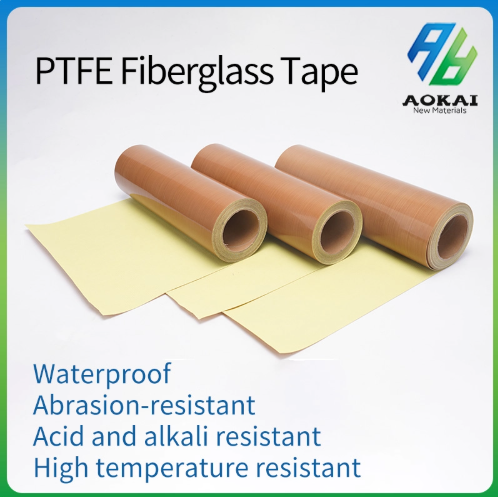
Imagine using PTFE high-temperature tape in a chemical tank liner, a marine cable wrap, or an underwater sealing application. The tape is submerged for weeks or months. Will it hold? Will the adhesive fail? Will the fiberglass soften?
The answer is not simple. PTFE itself – the “King of Plastics” – is chemically inert to nearly all substances. But a PTFE tape is more than just PTFE: it has a fiberglass substrate and a pressure-sensitive adhesive (PSA) on the back. These components behave very differently under long-term immersion.
Aokai PTFE has tested numerous tape grades in immersion conditions. This article breaks down the risks for water, saltwater, and chemical solutions – and explains which adhesive types survive.
Overall Principle – PTFE Substrate Is Strong, Adhesive Is Weak
For PTFE high-temperature tapes under long-term immersion, the overall performance can be summarized as:
PTFE base material: Excellent – chemically inert, non-absorbent, dimensionally stable.
Fiberglass substrate: Vulnerable – can soften in water over extended periods.
Adhesive layer: The main weak point – degrades under prolonged exposure to water, solvents, or chemicals.
Component
Performance Under Immersion
Failure Mode
PTFE coating
Excellent
None – remains inert
Fiberglass fabric
Moderate
Softening, strength loss after weeks/months
Silicone PSA
Fair to poor
Adhesion loss, swelling, peeling
Acrylic PSA
Very poor
Rapid degradation in water/solvents
Long-Term Water Immersion Risks
How water affects the tape:
Adhesive layer: Silicone pressure-sensitive adhesive is weakened by prolonged exposure to water molecules. Water penetrates the adhesive-substrate interface, reducing adhesion and eventually causing complete failure. Peel strength can drop by up to 40% after 48 hours of water immersion for some formulations.
Fiberglass substrate: Most commercial PTFE high-temperature tapes use fiberglass fabric impregnated with PTFE as the substrate. Fiberglass will soften in water over extended periods, leading to a decline in the overall mechanical strength of the tape. This is a slow process (weeks to months) but irreversible.
Continuous immersion for days or weeks – not recommended for standard silicone PSA tapes.
For permanent underwater use, consider adhesive-free PTFE tape with mechanical fixation.
Aokai PTFE advises customers that standard silicone PSA tape is suitable for applications with occasional water contact (e.g., food processing washdowns) but not for continuous submersion beyond 72 hours. For longer durations, we recommend fluorosilicone adhesive or adhesive-free grades.
Saltwater Immersion – Higher Risk
Compared with pure water, saltwater poses greater threats:
Chloride ions accelerate penetration and damage to the adhesive layer.
Saltwater causes more severe corrosion to fiberglass substrates – the glass fibers can leach and weaken.
Salt crystallization during drying cycles can mechanically disrupt the adhesive bond.
Recommendation: Do not use standard PTFE tape for long-term saltwater immersion (e.g., marine cable wraps, underwater sensors). Use perfluoropolyether (PFPE) adhesive or adhesive-free PTFE with mechanical clamping.
Chemical Solution Immersion – Depends Entirely on Adhesive
PTFE tapes excel in chemical resistance – but this largely depends on the adhesive type. The risks under chemical immersion vary significantly.
Adhesive Type
Chemical Resistance
Application Recommendation
Acrylic PSA
Poor – not resistant to strong acids, strong alkalis, or most organic solvents
Strictly prohibited for any chemical immersion
Conventional Silicone PSA (mainstream)
Moderate – resists water, weak acids, weak alkalis, and some solvents. Fails under long-term immersion in concentrated strong acids, strong alkalis, and highly polar solvents (e.g., acetone, MEK)
Suitable only for light chemical splash protection – not for continuous immersion
Fluorosilicone Modified PSA
Good – far superior to ordinary silicone in chemical resistance; withstands short-term immersion
Ideal for medium-term immersion (days to weeks) and moderate anti-corrosion conditions
Perfluoropolyether / Fluorine-based Adhesive
Excellent – matches the chemical resistance of PTFE substrate; barely affected by common chemicals
Preferred for severely corrosive environments and long-term immersion (months). Higher cost.
Pure PTFE Tape (No Adhesive)
Superior – no adhesive-related defects; chemical resistance identical to PTFE substrate
Top choice for liquid immersion. Requires mechanical fixation (thread sealing, bolt clamping, wire binding)
Physical Performance Degradation – Key Metrics
Property
PTFE Substrate
Adhesive Layer
Notes
Peel Strength
N/A
Can decrease by up to 40% after 48-hour water immersion (for UV-curable PSA)
Key indicator of tape failure
Tensile Strength
No loss after 200 days at 250°C
N/A
C-F bonds provide outstanding stability
Swelling
None – even in 98% H₂SO₄ or 40% HF
Swells in solvents (toluene, acetone, MEK)
Adhesive swelling leads to edge lifting
Corrosion Resistance
>95% tensile strength retained after 168h in boiling 37% HCl
Varies by type
Fiberglass can be attacked by HF and strong bases
Electrical Insulation
Reliable
Degradation can reduce dielectric strength
Select products meeting insulation requirements
Key takeaway: The PTFE substrate is remarkably stable. Almost all degradation risks come from the adhesive and, to a lesser extent, the fiberglass substrate.
Summary & Selection Guide for Immersion Applications
Immersion Environment
Recommended Tape Type
Why
Fresh water, intermittent
Standard silicone PSA
Acceptable for splashes, washdowns
Fresh water, continuous (>7 days)
Fluorosilicone PSA or adhesive-free
Standard silicone will lose adhesion
Saltwater, any duration
Adhesive-free PTFE + mechanical fixation
Salt attacks both adhesive and fiberglass
Weak acids/bases (pH 4-10), intermittent
Standard silicone PSA
Acceptable
Strong acids/bases, organic solvents, continuous
Adhesive-free PTFE (mechanical fixation) or PFPE adhesive
Only these survive
High-temperature immersion (>150°C)
Silicone or fluorosilicone PSA
Acrylic fails; PTFE substrate is fine
In summary, PTFE high-temperature tape can be used in immersion applications – but only if you understand the weak points. The PTFE substrate is nearly invincible. The fiberglass is moderately vulnerable. The adhesive is the primary failure risk.
For fresh water immersion under 72 hours, standard silicone PSA is acceptable. For longer durations, saltwater, or aggressive chemicals, upgrade to fluorosilicone, PFPE adhesive, or – best of all – adhesive-free PTFE tape with mechanical fixation.
Need a PTFE tape spec for a specific immersion environment? Aokai PTFE offers multiple adhesive options and can provide test data for your conditions. Contact us with your medium, temperature, and expected immersion duration.
We adhere to the philosophy of professionalism and integrity, and are committed to providing one-stop solutions and considerate services for all customers.