In food processing plants, medical device factories, and certain industrial facilities, gamma rays or electron beams are used for sterilization. If you need to use PTFE high-temperature tape in these environments – or worse, in a nuclear power plant – you must understand its radiation resistance limits.
The short answer: PTFE is highly susceptible to ionizing radiation. It performs well in low-dose applications (like food sterilization) but fails catastrophically at high doses.
Aokai PTFE has tested PTFE tapes under various radiation conditions. This article explains the degradation mechanisms, dose thresholds, and where you should never use PTFE tape.
Core Fact – PTFE Has Poor Radiation Resistance
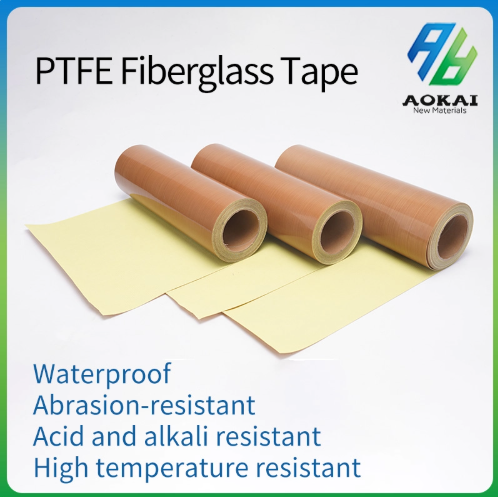
The core component of PTFE high-temperature tape is polytetrafluoroethylene (PTFE). Unlike its excellent thermal and chemical stability, PTFE is highly susceptible to ionizing radiation such as gamma rays and electron beams.
Why? Radiation breaks the carbon-fluorine (C-F) bonds and the polymer backbone, causing molecular chain scission. The material becomes brittle and loses mechanical strength.
Practical implication: PTFE tape is only suitable for environments with low radiation doses. It is generally prohibited for high-radiation scenarios like nuclear reactor cores or primary loops.
Performance Degradation Under Radiation – By the Numbers
When exposed to radiation, PTFE molecular chains break, resulting in a sharp decline in mechanical properties. The specific changes are shown below:
Elongation loss up to 87%; tensile strength loss 54%
Additional data:
In inert atmosphere (vacuum, nitrogen, or deuterium), degradation is slower but still unavoidable.
Thermal-radiation coupling (high temperature + radiation) accelerates aging further.
Aokai PTFE advises customers that our standard PTFE tape is qualified for food sterilization (≤10 kGy) and single-cycle medical device sterilization (≤50 kGy). For cumulative doses above 100 kGy or multiple sterilization cycles, we recommend switching to polyimide tape.
Environmental Factors That Accelerate Degradation
Factor
Effect on PTFE Under Radiation
Atmosphere (oxygen)
Oxygen accelerates degradation – free radicals react with O₂, causing more chain scission
Inert atmosphere (vacuum/N₂)
Degradation is reduced but still significant – cannot be avoided entirely
Moisture may promote surface hydrolysis, worsening embrittlement
Practical guidance: If you must use PTFE tape in a low-dose radiation environment with air present, replace it frequently. In vacuum or inert gas, life is extended but not unlimited.
✅ Acceptable – may become brittle after multiple cycles
Pharmaceutical equipment
10-25 kGy
✅ Acceptable – replace after each cycle for critical use
Non-core areas of nuclear plants (e.g., pipe insulation fixing)
Low dose, modified PTFE required
⚠️ Only if specially modified – standard PTFE not recommended
High-Radiation Scenarios to Avoid (>100 kGy)
Application
Cumulative Dose
Why PTFE Fails
Better Alternative
Nuclear reactor core
>1 MGy
Material crumbles
Polyimide (Kapton) or PEEK
Primary loop components
100 kGy – 1 MGy
Severe embrittlement
Polyimide / PEEK
Spacecraft exterior
High-energy particle radiation
Cannot withstand long-term exposure
Polyimide / PEEK
High-dose gamma sterilization (>100 kGy)
>100 kGy
Strength loss >80%
Polyimide
Summary – Know the Limit
Radiation Dose Level
PTFE Tape Performance
Recommendation
< 10 kGy (food sterilization)
No visible degradation; mechanical properties largely retained
✅ Safe for use
10 – 50 kGy (medical sterilization)
Some embrittlement; tensile strength reduced 30-50%
⚠️ Use once, then replace
50 – 100 kGy
Severe embrittlement; surface cracking
❌ Not recommended
> 100 kGy
Material crumbles; releases corrosive gases
❌ Prohibited – use polyimide or PEEK
Key takeaway: Weak radiation resistance is a major limitation of PTFE high-temperature tape. It is only qualified for low-dose radiation environments (food and medical sterilization). It delivers excellent high-temperature resistance and chemical stability in those settings. For high-radiation fields such as nuclear reactors or spacecraft, professional radiation-resistant materials must be adopted.
In summary, PTFE tape is not a radiation-resistant material. At just 1 kGy of gamma exposure, its tensile strength drops to 25% of original. It is suitable only for low-dose applications like food and medical sterilization (≤50 kGy). For cumulative doses above 100 kGy – such as nuclear reactor cores, primary loops, or spacecraft exterior – PTFE is prohibited.
If your application involves radiation, first determine the expected cumulative dose. Below 10 kGy, PTFE tape works fine. Between 10-50 kGy, use once and replace. Above 50 kGy, switch to polyimide or PEEK.
Need help selecting the right tape for a radiation environment? Aokai PTFE can provide dose-specific test data and alternative recommendations. Contact us with your radiation source, expected dose, and application details.
If you wish to know more about the detailed parameters, application scenarios, and customized solutions of our full product line, including PTFE high-temperature cloth, PTFE high-temperature tape, PTFE high-temperature mesh belt, seamless fusing machine belt, single-sided PTFE cloth, high-temperature resistant conveyor belt and high-temperature resistant fiberglass cloth, please feel free to contact us: