![Expanded Fiberglass Fabric Vs. Conventional Fiberglass Fabric: Key Differences And Applications]()
2026-06-17 Expanded fiberglass fabric (bulked yarn fabric) differs fundamentally from conventional fiberglass fabric in yarn structure. Through high-pressure air jet treatment, continuous glass filaments are separated, crimped, and fluffed into voluminous, cotton-like yarn. This creates thicker, softer fabric with superior thermal insulation (trapped air layers), better conformability, higher filtration efficiency, and improved tear/flex resistance – at the cost of slightly lower tensile strength. Used for high-temperature gaskets, pipe wraps, filter bags, and oven seals.
Read More ![How Raw Material Purity Affects PTFE High-Temperature Fabric Performance]()
2026-06-16 Raw material purity is the foundation of PTFE high-temperature fabric performance. High-purity PTFE emulsion (no metal ions, no low-molecular-weight residues) ensures heat resistance (no yellowing up to 260°C), stable non-stick, and high dielectric strength. For fiberglass, alkali-free E-glass (Na₂O <0.8%) maintains strength and insulation at high temperatures; medium/high-alkali glass causes degradation. Complete removal of weaving sizing agents prevents carbonization and delamination. Purity directly affects service life, food-grade compliance, and electrical reliability.
Read More ![Fiberglass Fabric Pre-Drying: How to Control Temperature and Time Correctly]()
2026-06-16 Proper pre-drying of fiberglass fabric is critical for subsequent PTFE coating, resin impregnation, or lamination. Three main treatments: moisture removal at 105-120°C (10-30 min depending on weight), dewaxing/thermal cleaning at 300-450°C (LOI <0.1%, avoid>500°C), and preheating at 60-100°C before coating. Control oven temperature uniformity (±5°C), forced dehumidification, and protect silane-treated fabrics below 110°C. Store dried fabric in sealed bags or dry rooms (<30°C, <40% RH).
Read More ![PTFE Tape Salt Spray Resistance & Marine Application Requirements]()
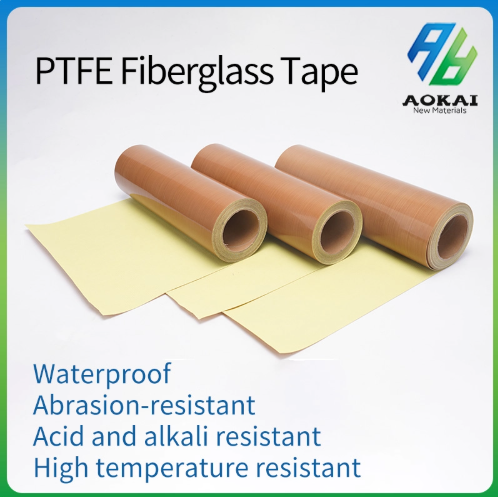
2026-06-16 PTFE high-temperature tape has excellent salt spray resistance, but the weak points are the adhesive layer and the fiberglass substrate edges. Evaluation methods: 1000h neutral salt spray (NSS) test, measuring peel strength retention (≥80% required), visual defects (lifting, blistering), and metal substrate corrosion. For marine and high-salt-fog environments: use silicone PSA (not acrylic), fully impregnated PTFE substrate, seal edges with weather-resistant sealant, and apply primer on metal surfaces.
Read More ![Which Chemicals Can Corrode PTFE High-Temperature Fabric?]()
2026-06-15 PTFE high-temperature fabric (PTFE-coated fiberglass) is nearly chemically inert, but certain substances cause corrosion under specific conditions. Direct PTFE attack occurs with molten alkali metals (sodium, potassium), strong fluorinating agents (F₂, ClF₃) at high temperatures, and molten strong alkalis above 300°C. Indirect corrosion happens when hydrofluoric acid (HF), hot concentrated alkalis, or hot phosphoric acid penetrate coating defects and attack the fiberglass substrate. For extreme chemical service, use pure PTFE film without fiberglass.
Read More ![PTFE Tape Reusability: How to Improve Repeated Adhesion Performance]()
2026-06-15 PTFE high-temperature tape loses adhesion after repeated use due to surface contamination (dust, silicone oil), adhesive cohesive failure (residue), or weak substrate bonding. Solutions: high-crosslink silicone PSA (low migration, balanced tack/holding power), primer treatment on the PTFE substrate, dense fiberglass backing, and proper handling (clean surfaces, cool peel, 180° angle). Quantitative testing validates improvement.
Read More ![How Well Does PTFE High-Temperature Fabric Handle Thermal Shock?]()
2026-06-15 PTFE high-temperature fabric (PTFE-coated fiberglass) has excellent thermal shock resistance within its normal operating range of -70°C to 260°C. It can tolerate rapid temperature cycling, e.g., moving from a -50°C freezer to a 260°C hot press. Premium grades even survive sudden cooling from 260°C into 10°C water. However, shocking the material from temperatures above 300°C (near PTFE’s 327°C melting point) will cause immediate cracking and delamination. The fiberglass substrate provides dimensional stability; the PTFE coating is the limiting factor.
Read More ![PTFE High-Temperature Fabric in The Chemical Industry: 7 Key Applications]()
2026-06-12 PTFE high-temperature fabric is widely used in the chemical industry for seven key applications: flange gaskets and pipe linings (resists strong acids/alkalis), reactor and tank linings (prevents metal corrosion, easy cleaning), filter bags for corrosive flue gas (up to 260°C), anti-corrosion expansion joints for ducts, anti-adhesion welding pads, release cloth for composite molding, and electrical/thermal insulation wraps. FDA and UL grades available.
Read More ![PTFE Tape Shelf Life: What You Need To Know for Proper Storage]()
2026-06-12 PTFE high-temperature tape stored under specified conditions (10-25°C, 40-70% RH, away from UV/heavy pressure) has a standard shelf life of 3-6 months (premium grades up to 12 months). Key degradation thresholds: peel strength must not drop below 70% of initial value; no adhesive residue after high-temperature removal; no carbonization or cracking at rated temperature. Quick checks: manual unwinding feel, 260°C residue test, and lamination shrinkage test.
Read More ![Why Use PTFE High-Temperature Fabric as an Anti-Corrosion Lining? 4 Key Advantages]()
2026-06-11 PTFE high-temperature fabric (PTFE-coated fiberglass) offers four key advantages as an anti-corrosion lining: chemical inertness (resists aqua regia, strong alkalis, solvents), wide temperature range (-70°C to 260°C continuous, 350°C peak), dimensional stability (<0.5% elongation), and non-stick surface (easy cleaning, prevents buildup). Used in chemical pipelines, desulfurization towers, pickling tanks, and food/pharma equipment. FDA grades available.
Read More